
Bengali folktale · Mymensingh, East Bengal
Lalkamal and Neelkamal
7 min read · Theme: Courage, loyalty, and sibling love
Source: From Thakurmar Jhuli (1907), collected by Dakshinaranjan Mitra Majumder
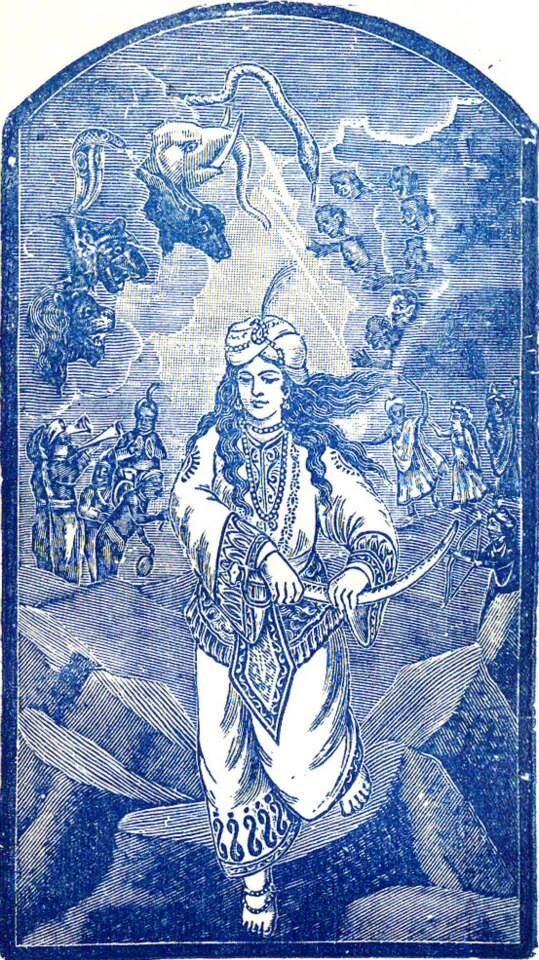
A king has two queens, and one of them is secretly a rakkhoshi, a man-eating demoness. Her son Ajit and his half-brother Kusum love each other so dearly that not even death can part them: reborn from a red egg and a blue egg as Lalkamal and Neelkamal, they fight demons, outwit the rakkhoshi kingdom and come home.
Once upon a time a king had two queens. One was a kind, gentle woman. The other was beautiful too, but nobody knew her secret: she was a rakkhoshi, a demoness who ate human flesh, hiding inside a human shape. Each queen had a son. The gentle queen's boy was called Kusum, which means 'flower'. The rakkhoshi's boy was called Ajit, 'the unconquered'.
The two half-brothers were inseparable. They ate from the same plate, learned their lessons side by side and slept in the same bed. The rakkhoshi queen burned to eat her rival's son, but Ajit never left Kusum alone for a moment, and she could find no chance.
So she turned her eyes on the gentle queen instead. With nothing more than her stare she drained the poor woman's strength, until one day Kusum's mother fell ill and died. The whole kingdom wept, and no one guessed why. Then the rakkhoshi secretly called her demon kin into the city. One night one of them burst into the room where the king slept with the two boys, seized Kusum and swallowed him whole.
So the king was left alone in the world. His gentle queen dead, his two sons swallowed by the very woman who sat beside him, he wandered the palace at night like a man in a dream. He suspected nothing — how could anyone suspect a queen? Only Ajit's empty bed and Kusum's little toys told him what he had lost. In the land of the living, not one person knew where his sons were.
The king froze with terror. But Ajit leapt up and struck the demon so hard that it fled — and as it ran it coughed up a ball of gold. Mad with fury that her own son had stood against her, the rakkhoshi queen swallowed Ajit too. At once a ball of iron rolled from her mouth onto the floor.
The two balls frightened her; she could smell danger in them. In the dead of night she buried them beneath a clump of bamboo far from the palace and sent the other demons home. Seasons passed. One day a farm labourer came to cut bamboo, and inside two of the stems he found two eggs — one red, one blue. Thinking they were snake's eggs, he ran away. The moment he was gone, out of the blue egg stepped Kusum, and out of the red egg stepped Ajit.
From then on they were known by the colours of their eggs: Ajit became Lalkamal, the Red Lotus, and Kusum became Neelkamal, the Blue Lotus. They left their father's land and walked to another kingdom, where khokkosh demons came every night and carried off the people by the hundred. That king had dreamed that two princes would save him, and he had promised them his two daughters and half his kingdom.
The brothers offered to keep watch in the haunted hall. Lalkamal said, 'I'll sleep first. But if they come while you are on guard, never say you are alone — say that both of us are awake.' At midnight came the dreadful chant: 'Haun maun khaun, I smell a human!' Neelkamal called back boldly: 'Lalkamal and Neelkamal are awake, and their swords are drawn!'
The khokkoshes shrank back, for they knew that rakkhoshi blood ran in Lalkamal's veins. 'Show us Lalkamal's nose through the crack in the door!' they demanded. Neelkamal pushed out the tip of a sharp knife. 'Show us his spit!' He flung burning ghee from the lamp, and it blistered their hides. 'Show us his tongue!' He thrust out his sword, and when they grabbed it, their leader's fingers were sliced.
But as the night wore on, Neelkamal grew drowsy. When the demons asked once more who was inside, he mumbled only his own name. They burst in to tear him apart — and Lalkamal woke, sprang up and cut them all down. In the morning the city found a mountain of dead khokkoshes, and the king gave the brothers his daughters and half his kingdom, just as he had promised.
The city, which had not slept in peace for years, sang for a week. Priests blessed the brothers, the princesses' maids hurried about with silks and ornaments, and the two princesses, hearing of the midnight battle, looked at the strangers from another land with new eyes. Of the brothers, Neelkamal grew quiet and thoughtful, and Lalkamal never once boasted of the rakkhoshi blood in his veins — though everyone knew it was there.
Far away, the rakkhoshi queen learned by magic that the boys were alive. She sent two demon servants disguised as messengers: 'Your father is dying. Only rubbing him with a rakkhoshi's brain can save him.' The loyal sons set out at once for the land of the demons. Resting one evening under a great banyan, they heard the magic birds Bangoma and Bangomi talking above them. Their chicks were blind, and only Lalkamal's touch could heal them.
At dawn Lalkamal touched the chicks and they could see. In thanks the mother bird gave the brothers a pocketful of fried peas and lent them her young ones to fly on. 'When the demons test you by making you chew iron pellets,' she said, 'slip the peas into your mouths instead.'
They flew for three days. Below them passed forests where no man had ever walked, rivers like silver threads, and burning deserts where the wind roared like a beast. On the third evening the young birds landed on a plain of ash and bone, and the brothers knew they had reached the border of the demon land. Lalkamal warned his brother: 'Whatever they offer you, eat nothing until you have chewed their iron.'
In the demon country the rakkhoshis crowded round, sniffing at Neelkamal: 'Haun maun khaun!' Lalkamal stepped forward. 'Grandmother, we are your grandsons, come to visit!' The old rakkhoshi handed them iron pellets to chew as proof. The brothers secretly crunched the fried peas, and the demons, satisfied, treated them as honoured guests.
Days passed in the demon house. The brothers moved carefully — serving the old rakkhoshi, laughing at the demons' boasts — and all the while one question turned in their minds: what is it that a demon cannot fight? At last, on the fifth night, an old she-demon let fall, in her cups, that the lives of them all were locked in a casket at the bottom of the well behind the house. The brothers looked at each other once, and said nothing.
One day, while the demons were out hunting, the brothers dived into a well behind the house and brought up a casket. Inside were two hornets. In one lived the lives of every demon in the land; in the other, the life of the rakkhoshi queen herself. As they lifted the first hornet, the demons felt their hearts pound and came running home. The brothers tore off its legs, and every demon fell limbless; they pulled off its head, and all of them dropped dead.
The birds carried the brothers home. When the rakkhoshi queen saw what they had done, she threw off her disguise, rose up in her true monstrous form and rushed at them. Lalkamal crushed the second hornet, and she fell dead at once. With the demons gone, the kingdom was safe. The king welcomed his sons home, the two princesses joined them, and Lalkamal and Neelkamal — who had shared one bed, one death and one rebirth — lived the rest of their lives side by side.
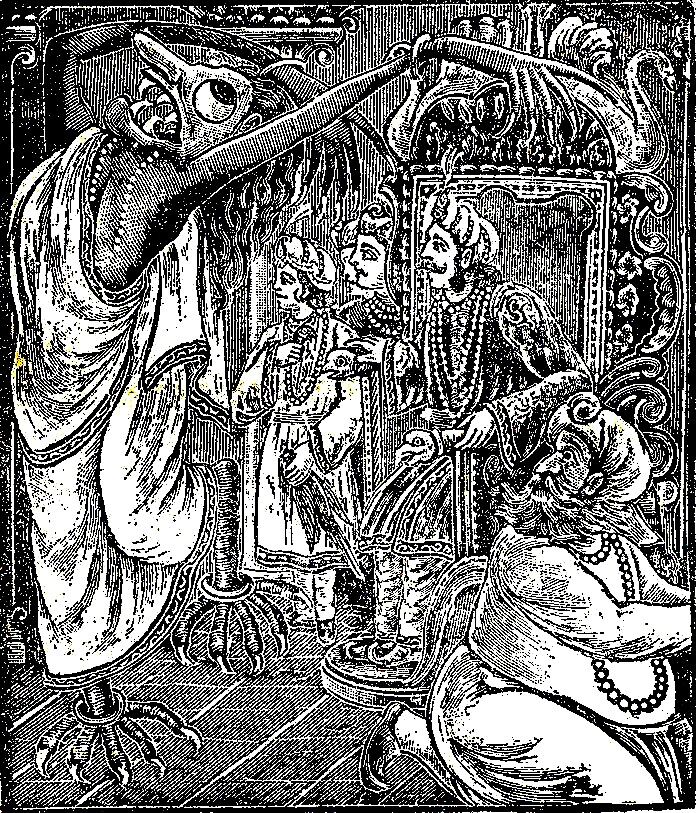
“Courage, loyalty, and sibling love”
The complete story, retold in our own words for this archive from the original text.